




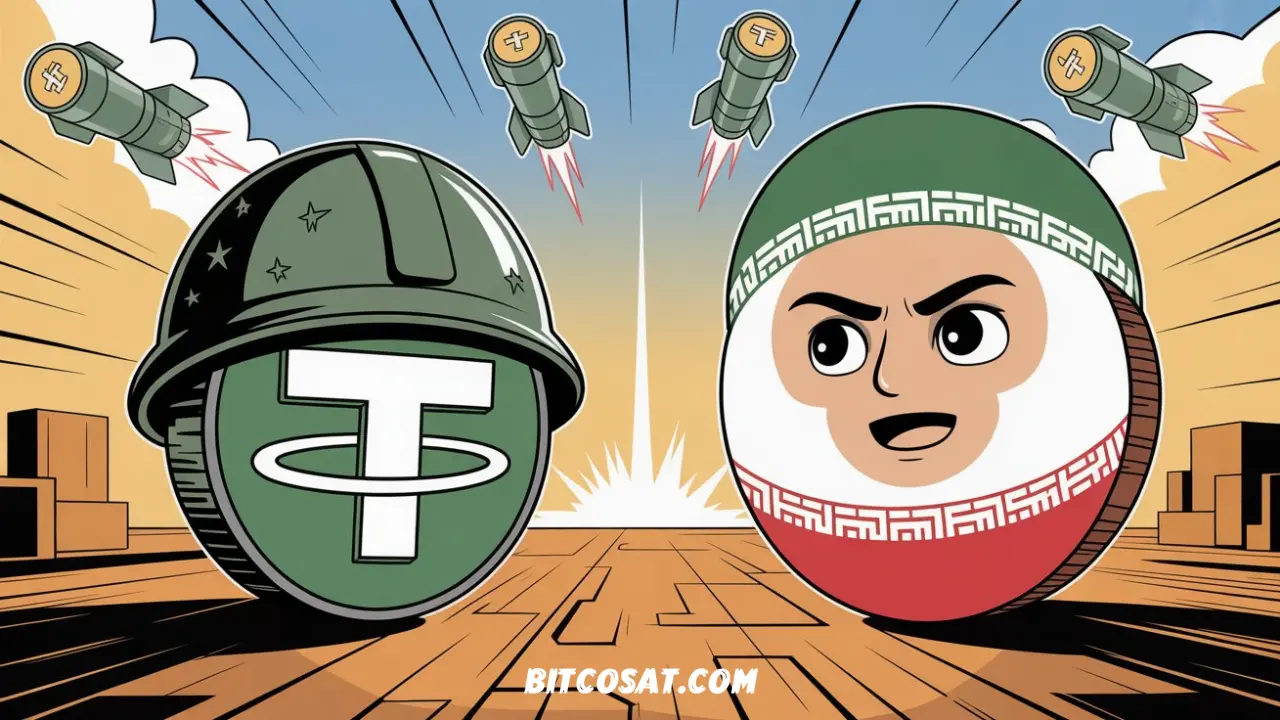
Experts said the decision puts people’s savings at risk and will force capital out of the country amid the historic decline in the currency’s value.
A stablecoin is a digital currency designed to maintain a stable price value, typically by pegging it to another asset, such as a fiat currency (e.g., the US dollar or euro) or a commodity (e.g., gold).
Its primary purpose is to provide a stable alternative to the high price volatility of traditional cryptocurrencies, making it more suitable for digital transactions and money transfers.
A Tehran-based economist who preferred to remain anonymous confirmed that “restrictions on stablecoins will not halt demand for the dollar, but will push it underground.”
Late last month, the Central Bank’s Supreme Council approved an annual purchase cap of $5,000 per person and a maximum holding of $10,000 in stablecoins.
This decision came as the Iranian rial hit a record low earlier this month, reaching 1,170,000 rials to the dollar.

This collapse occurred after the reimposition of UN sanctions following the activation of the trigger mechanism by European countries, and the accompanying concerns about Iran’s nuclear activities. At the time of publication, the rial was trading at approximately 1,140,000 to the dollar.
Even some government officials criticized the decision. Ehsan Jit Saz, Deputy Minister of Communications, wrote on the X platform:
The disaster is when a decision-maker decides with good intentions, but based on flawed principles and disregarding the evidence. The result is nothing but weakened governance, eroded public trust, threatened people’s property, and undermined the credibility of institutions.
Crypto market activists’ reaction
Crypto market activists, speaking to Iran International, described the new limits as impractical and punitive.
Farzad, a 29-year-old trader from Tehran, said:
Every time the government fails to find a solution to the currency’s collapse, it tightens restrictions further. In the name of regulation, they place the burden of the crisis on the people alone. When the market collapses, we fall into a trap: we cannot liquidate our assets or protect them.
Barham, a 25-year-old from Tehran, said:
Even people’s spending is determined by the government based on their jobs; 50 billion rials for the unemployed and 200 billion for those with salaries. These restrictions kill the spirit of innovation and push people towards informal means.
He pointed to another central bank circular issued last week that set progressive limits on riyal transactions, including a ceiling of 200 billion riyals for employed individuals, 50 billion riyals for the unemployed, and 5 billion riyals for inactive entities.
The economist mentioned above said that these regulations and the accompanying media campaign are an attempt to artificially control the market. He added:
The $5,000 ceiling on Tether has nothing to do with stability; it’s merely a cover for manipulation. They’re sucking up liquidity under the pretext of regulation to buy time while the riyal continues to fall. Fear of asset freezes is causing panic, prompting people to sell at a loss.
The Revolutionary Guards’ Tasnim News Agency reported that thousands of addresses on the Tether network have been frozen so far, effectively rendering their assets inaccessible.
The agency then called for stricter oversight of trading platforms like Nobitex.
Black market expansion
Experts have warned that these restrictions will lead to the growth of the parallel economy. Saeed Reza Moradian of OTC Exchange said:
Tether’s $5,000 cap will lead to the proliferation of rental accounts.
Social media users also wrote that people’s needs will not disappear, but will instead shift to foreign and non-transparent platforms.
Bitcosat also observed advertisements offering to rent out their national numbers to take advantage of the $5,000 stablecoin quota.
Central bank officials claim this measure is necessary to prevent capital outflows and that users have one month to comply with the new regulations. However, crypto traders view this law as unworkable.
Farrukh, a trader based in Tehran, said:
Digital assets cannot be controlled with outdated banking instruments. When trust is lost, people don’t wait; they move their money out of the country by any means necessary.
Statements by economic activists reveal the widening gap between official policies and public behavior. Many families and small traders who previously used Tether to protect their assets against inflation are now caught between violating the law and losing their savings.
For many Iranians facing a new wave of rial collapse and the return of UN sanctions, the Central Bank’s decision represents a fresh blow to their financial independence.
Experts say it will narrow legal channels, expand informal trade, and deepen the gap between the people and a banking system already suffering from a crisis of confidence.
