




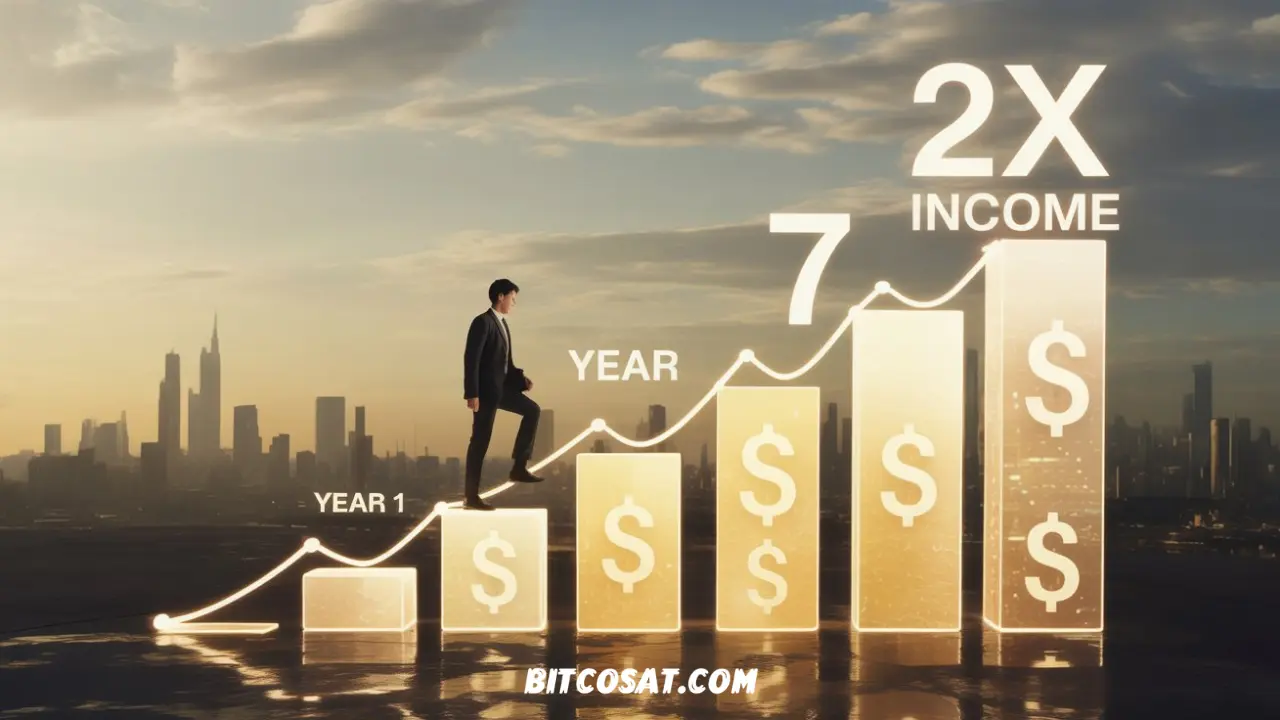
Despite stagnant salaries in many jobs, building wealth is not impossible. With smart and organized financial planning, anyone can double their income in just a few years, even if their salary doesn’t increase at all.
The secret lies not in how much money you earn, but in how you manage it. This isn’t just a theory; it’s the real-life experience of Brennan Schlagbaum, a wealth management consultant and financial content creator, who successfully transformed over $300,000 in debt into a fortune exceeding $4 million in less than a decade.
In a post on the X platform, Schlagbaum wrote: “If you can’t manage $100,000, you’ll also fail to manage $1 million.” It’s not how much you have, but how you use it.
According to Robert Kiyosaki, author of “Rich Dad Poor Dad,” the rich make money work for them, but is there a minimum to get started?
Many billionaires and wealthy individuals believe that building wealth requires commitment to a well-defined plan and a deep understanding of the nature of money. But how can one create a plan to build wealth?
Let’s start by focusing on doubling income without taking into account that salaries increase annually in most companies and countries.
How to double your income?
Investment and financial markets expert Dr. Khaled Kandil advises the necessity of developing a balanced plan according to income bracket, distributed proportionally across 6 main categories: basic needs, crisis reserve, donations, training and development, investment, and entertainment.
Kandil said that the diversity of income brackets and the difference in each person’s tolerance for risk necessitates the development of diverse strategies that can be divided into 4 basic strategies, starting from those with limited income and ending with those with high income, which can be divided as follows:
1. Low-income strategy
The strategy focuses on low-income earners according to the nature of income in each region or country, but when calculated in Egyptian pounds, it is intended for those whose income is less than 12,000 pounds.
While doubling income through investment may seem difficult for this segment, even with a fixed salary over the lifespan of the strategy, which can extend to 20 years, income can double every 7 years compared to the previous seven years, provided that monthly investment is maintained.

With the reduced income of this segment, 70% of the income will be allocated to basic needs, 10% will be invested, and the remainder will be divided equally among the other four funds (entertainment, emergency, development, and charitable giving). Any of these four funds can be used to repay existing debts.
Kandil said that each path has its practical justification, apart from the basics. The emergency fund, for example, represents a guarantee of commitment to the strategy and not liquidating the investment to deal with emergencies, while giving represents a certificate of confidence from the person in what he accomplishes and reduces the psychological pressure associated with his feeling of need with every act of giving to others, and thus he can get rid of the feeling of fear and the need to hoard. As for development, it improves the person’s experiences and gives him better opportunities to remain competitive by transferring value from his work or job position to himself through accumulating experiences and development.
2. M strategy
Strategy M focuses on the middle-income segment with high obligations, and can be called the (60-40) strategy, where 60% of income is allocated to basics, and 40% to savings and investment, including emergencies, development, and giving.
It could be suitable for people with an income of less than £25,000, for example.
3. MM strategy
The third strategy targets middle-income earners with middle obligations, in which income is divided equally between basics and investment.
It is summarized as dividing income into 50% investment (5% giving and charity, 35% saving for investment, 5% saving for emergencies, and 5% self-development), and 50% spending (40% obligations and necessities, in addition to 10% entertainment).
4. KK strategy
It is a suitable strategy for middle-income earners with low obligations / high-income earners with middle obligations.
This can be summarized as dividing income into 65% investment (5% charity, 50% savings for investment, 5% emergency savings, and 5% self-development). The remainder is distributed among expenditures (30% obligations and necessities, and 5% entertainment).
The four previous strategies require investing savings on a monthly basis to increase the effectiveness of the return on investment, and the more investments are distributed across channels with high returns, the easier it is to accomplish the task.
The funds saved for investment can be distributed among instruments ranging from stocks and bonds to gold, real estate, and private projects.
While returns may be exceptional in 2026 for gold, silver, and stock markets, investing through an investment manager may ensure relative stability in risk-weighted returns, whether through purchasing fixed income fund units, money market funds, equity funds, or ETFs.
Even with regard to real estate investment, there are a large number of funds that enable partial investment in real estate, in addition to gold funds.
